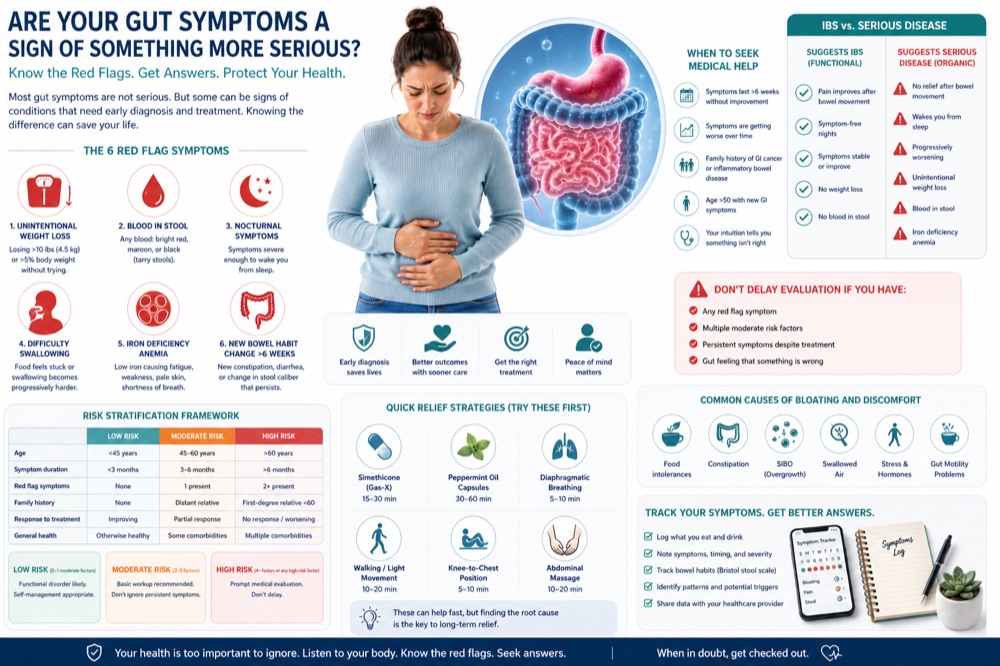
Tout ballonnement n est pas du gaz. Une distension organique demande un autre parcours que le SII typique.
Ce qui compte d’abord
Separez fonctionnel et organique: perte de poids, sang, vomissements, fievre, symptomes nocturnes ou debut apres 50 changent le seuil.
- Le ballonnement SII typique empire le jour et s attenue la nuit
- Ascite, obstruction ou masse pelvienne ne se resolvent pas au the menthe
- Age, sexe et alarmes guident imagerie et bilans, pas un detox maison
Détails qui aident vraiment
Ce qui change le plan
Evaluez si alarmes. Echo, bilans et si besoin endoscopie ou scanner. N empilez pas de remedes avec des alarmes.
Le cadre de deux semaines
-
Oui: noter timing, repas et tour de taille
-
Oui: lister les alarmes pour la consultation
-
Oui: revoir les medicaments qui ralentissent la vidange
-
Oui: chercher les urgences si vomissements et douleur intense
-
Non: attribuer tout sang aux hemorroides
-
Non: retarder l evaluation par peur des examens
-
Non: faire des jeunes extremes pour degonfler
-
Non: ignorer un debut apres 50
Signaux d’alarme — consultez si :
- perte de poids inexpliquée
- selles noires
- vomissements persistants
- évanouissement
- douleur nocturne intense
- sang dans les selles
Questions fréquentes
Quand le ballonnement est une urgence?
Vomissements persistants, douleur intense, fievre, ventre dur ou absence de gaz: urgences, pas d attente.
Sources
- American Cancer Society. Cancer Facts & Figures 2024. Atlanta: American Cancer Society; 2024.
- Ford AC, et al. American College of Gastroenterology monograph on the management of irritable bowel syndrome. Am J Gastroenterol. 2024;119(S1):S2-S31.
- Vasant DH, et al. British Society of Gastroenterology guidelines for the management of irritable bowel syndrome. Gut. 2024;73(7):1027-1058.
- Lacy BE, et al. Rome Foundation Updated Guidelines for Functional Gastrointestinal Disorders. Gastroenterology. 2024;166(1):38-57.
- National Institute for Health and Care Excellence (NICE). Suspected cancer: recognition and referral. NG12. 2024.
- American College of Obstetricians and Gynecologists. Evaluation and Management of Adnexal Masses. ACOG Practice Bulletin No. 174. 2024.
- Runyon BA. Introduction to the revised American Association for the Study of Liver Diseases Practice Guideline on the management of ascites due to cirrhosis. Hepatology. 2024;79(1):1-3.
- Ten Broeck RPG, et al. Adhesive small bowel obstruction: epidemiology, biology, prevention, and treatment. World J Surg. 2024;48(2):275-285.
- Chey WD, et al. ACG Clinical Guideline: Management of Celiac Disease. Am J Gastroenterol. 2024;119(2):203-222.
- Conlon KC. Pancreatic Cancer. In: DeVita VT, Lawrence TS, Rosenberg SA, eds. Cancer: Principles & Practice of Oncology. 12th ed. 2024.
- Camilleri M. Functional gastrointestinal disorders: advances in understanding and management. Lancet. 2024;403(10425):368-382.
- Black CJ, Ford AC. Global burden of irritable bowel syndrome: trends, predictions, and risk factors. Nat Rev Gastroenterol Hepatol. 2024;21(5):323-336.
- NIDDK. Symptoms & Causes of IBS. 2024. https://www.niddk.nih.gov/
- American Gastroenterological Association. AGA Institute Medical Position Statement on Evaluation of Abdominal Bloating and Distention. 2024.
- World Gastroenterology Organisation. WGO Global Guidelines: Irritable Bowel Syndrome. 2024.
- Cleveland Clinic. Abdominal bloating. 2024. https://my.clevelandclinic.org/health/symptoms/21740-abdominal-bloating