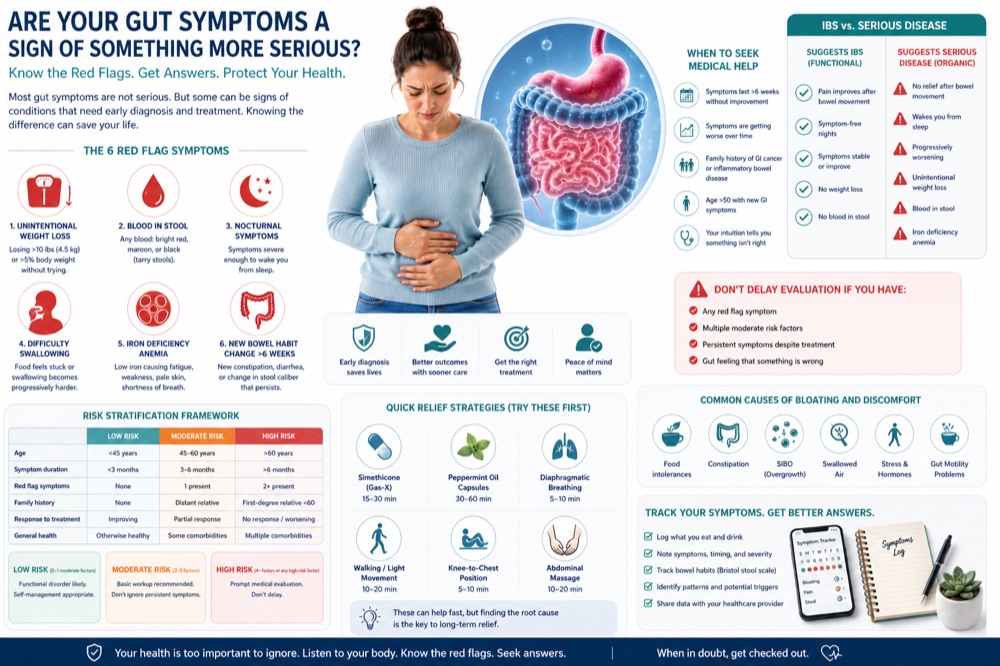
Nicht jede Bloehung ist Gas. Organische Distension braucht einen anderen Pfad als typisches Reizdarm.
Was zuerst zählt
Funktionell vs organisch: ungewollter Gewichtsverlust, Blut, Erbrechen, Fieber, Nachtsymptome oder Beginn nach 50 aendern die Schwelle.
- Typische Reizdarm-Bloehung steigt tags und laesst nachts nach
- Aszites, Obstruktion oder Beckenmasse loesen sich nicht mit Pfefferminztee
- Alter, Geschlecht und Alarmzeichen steuern Bild und Labor, kein Haus-Detox
Details, die wirklich helfen
Was den Plan aendert
Bei Alarmzeichen abklaeren. Ultraschall, Labor und bei Bedarf Endoskopie oder CT. Keine Mittel stapeln bei Warnzeichen.
Der Zwei-Wochen-Rahmen
-
Ja: Timing, Mahlzeiten und Bauchumfang notieren
-
Ja: Alarmzeichen fuer den Termin listen
-
Ja: Medikamente pruefen, die die Entleerung bremsen
-
Ja: bei Erbrechen und starkem Schmerz Notfall suchen
-
Nein: jede Blutung Haemorrhoiden zuschreiben
-
Nein: Abklaerung aus Angst vor Tests verzögern
-
Nein: extreme Fasten gegen Bloehung
-
Nein: neuen Beginn nach 50 ignorieren
Warnsignale — ärztliche Hilfe bei:
- unerklärlicher Gewichtsverlust
- schwarzer Stuhl
- anhaltendes Erbrechen
- Ohnmacht
- starke Nachtschmerzen
- Blut im Stuhl
Häufige Fragen
Wann ist Bloehung ein Notfall?
Bei anhaltendem Erbrechen, starkem Schmerz, Fieber, hartem Bauch oder fehlenden Winden: Notaufnahme, nicht warten.
Quellen
- American Cancer Society. Cancer Facts & Figures 2024. Atlanta: American Cancer Society; 2024.
- Ford AC, et al. American College of Gastroenterology monograph on the management of irritable bowel syndrome. Am J Gastroenterol. 2024;119(S1):S2-S31.
- Vasant DH, et al. British Society of Gastroenterology guidelines for the management of irritable bowel syndrome. Gut. 2024;73(7):1027-1058.
- Lacy BE, et al. Rome Foundation Updated Guidelines for Functional Gastrointestinal Disorders. Gastroenterology. 2024;166(1):38-57.
- National Institute for Health and Care Excellence (NICE). Suspected cancer: recognition and referral. NG12. 2024.
- American College of Obstetricians and Gynecologists. Evaluation and Management of Adnexal Masses. ACOG Practice Bulletin No. 174. 2024.
- Runyon BA. Introduction to the revised American Association for the Study of Liver Diseases Practice Guideline on the management of ascites due to cirrhosis. Hepatology. 2024;79(1):1-3.
- Ten Broeck RPG, et al. Adhesive small bowel obstruction: epidemiology, biology, prevention, and treatment. World J Surg. 2024;48(2):275-285.
- Chey WD, et al. ACG Clinical Guideline: Management of Celiac Disease. Am J Gastroenterol. 2024;119(2):203-222.
- Conlon KC. Pancreatic Cancer. In: DeVita VT, Lawrence TS, Rosenberg SA, eds. Cancer: Principles & Practice of Oncology. 12th ed. 2024.
- Camilleri M. Functional gastrointestinal disorders: advances in understanding and management. Lancet. 2024;403(10425):368-382.
- Black CJ, Ford AC. Global burden of irritable bowel syndrome: trends, predictions, and risk factors. Nat Rev Gastroenterol Hepatol. 2024;21(5):323-336.
- NIDDK. Symptoms & Causes of IBS. 2024. https://www.niddk.nih.gov/
- American Gastroenterological Association. AGA Institute Medical Position Statement on Evaluation of Abdominal Bloating and Distention. 2024.
- World Gastroenterology Organisation. WGO Global Guidelines: Irritable Bowel Syndrome. 2024.
- Cleveland Clinic. Abdominal bloating. 2024. https://my.clevelandclinic.org/health/symptoms/21740-abdominal-bloating